
Need to email your company file to your accountant, or move it to a different computer without dragging along every attachment and log file? A QuickBooks portable company file is built exactly for that a compact, lightweight version of your data that’s easy to transfer and just as easy to restore when you’re ready to work with it again. It’s also a handy fallback when things go wrong whether that’s a power outage, a ransomware attack, or an unexpected system crash that puts your regular company file at risk. Having a portable copy on hand, and knowing how to restore it properly, can save you from a much bigger headache down the line.
This article walks through what a portable company file actually is, how to create and restore one, what to do if Fixed Asset Manager or Loan Manager data doesn’t come along with it, and how to troubleshoot common restore issues. Worried about data loss in general? Our QuickBooks Data Recovery team is available at +1-888-510-9198 to help protect your important files.
Read Also: How to Setup QuickBooks Enterprise –Technical Support & Error Handling?
What is QuickBooks Desktop Portable Company file?
- QuickBooks portable company file is a compact copy or replica of the financial data which you send via email or any portable media like flash or external drive.
- This file does not include templates, letters, images, and logos.
- It also does not comprise of any transaction log (*.tlg) file.
- It is a proficient and eminent tool to solve the data problems because QB desktop re-indexes the data while restoring the portable company file.
Few Important Points to Remember:
Before you create or restore a portable file, keep these points in mind they’ll help you avoid a few common mistakes:
- Make sure that QuickBooks software is up to date before troubleshooting.
- All QuickBooks versions need you to log in as the Admin to create & return the portable replica or copy.
- In case, you provide the copy of the portable copy to someone – they will automatically gain all the access of the QuickBooks & will be able to add/modify the transaction & alter the Administrator password.
- In case, you made an attempt to solve the data issues, make sure that you do not overwrite the original file while restoring the portable copy. The best method is to rename the original file before restoring the portable company file.
- Consider using the accountant’s copy while sending the company file to the accountant.
Steps to Creating/Establish a Portable Company File
- Go to the File menu, choose the Create Copy.
- Choose the Portable company file and then, Next.
- Find out the location where you want to save the portable copy.
- Choose Save and then, OK.
Steps to Restore a QuickBooks Portable Company File
You can follow the steps given below to restore a local backup that can be done with the help of a CD, USB flash drive, network folder or hard drive. In case you have backed up your company file by using the service provided by QuickBooks Online Backup, then you should restore the same through that device only.
You can follow the steps given below in order to restore a backup company file:
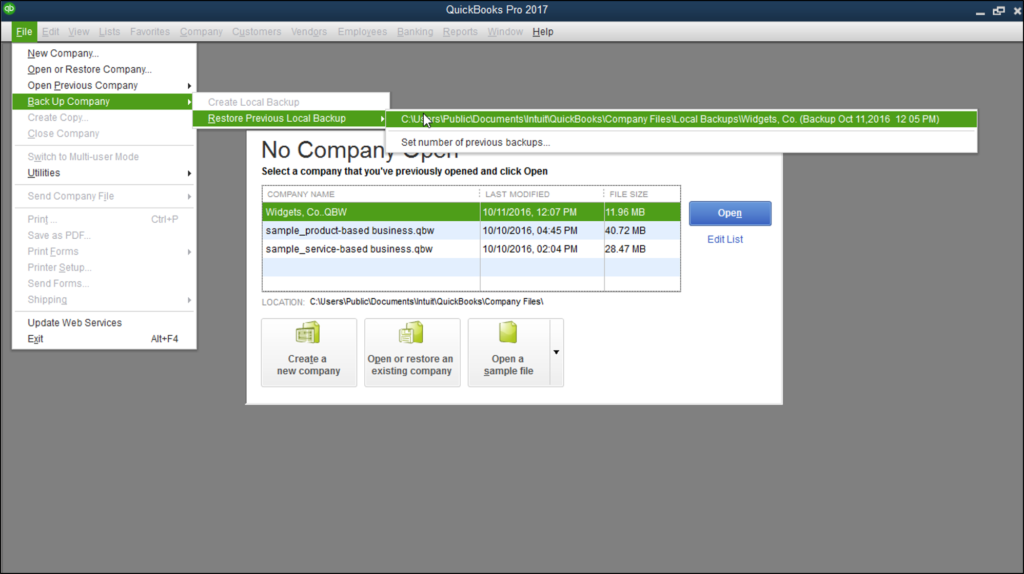
- Go to File menu, and choose Open or Restore Company.
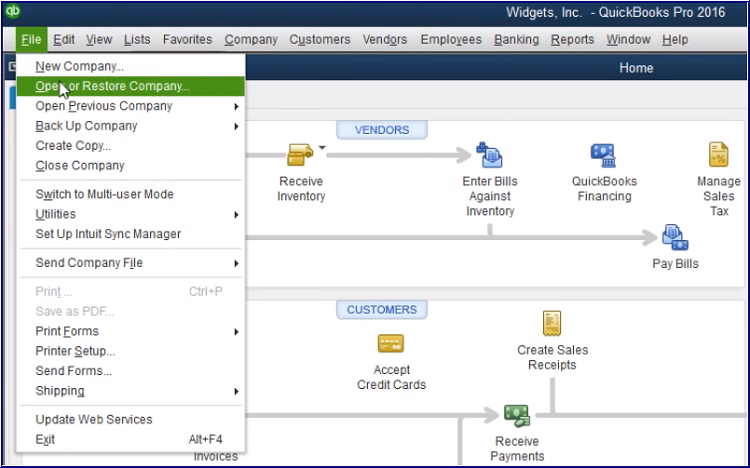
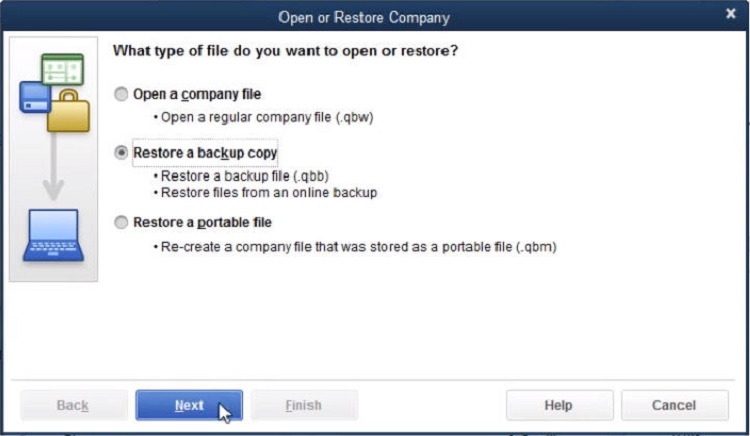
- Then click on Restore a backup copy and then click on Next.
- Choose Local Backup and then, click Next.
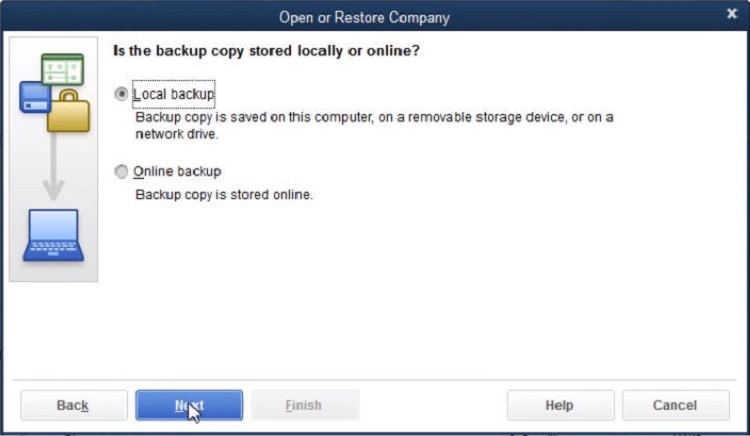
- A dropdown will appear from that dropdown select the location of the backup file where you want to save it.
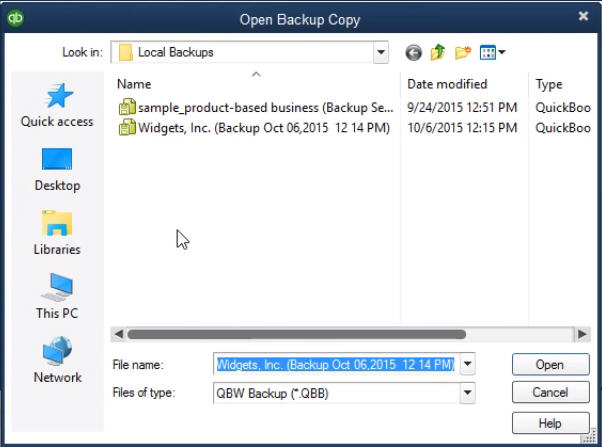
- After that, select the backup file from folder and give it a name.
- Click on Open and then press Next
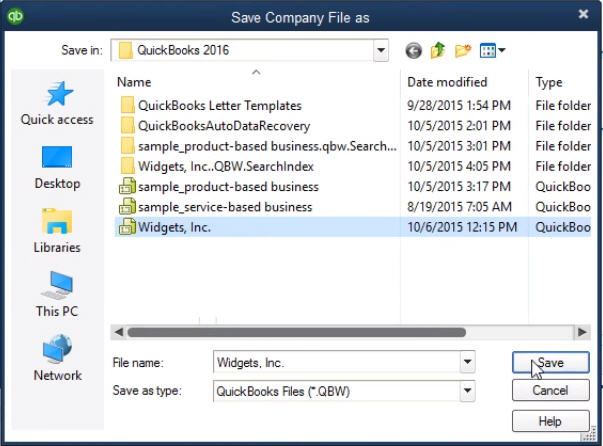
- Save-in drop-down will appear, save the restored file.
- Save a type field automatically populates QuickBooks Files.
- Select Save, and carefully read and remember to respond to all the messages that appear before the restoration begins.
If you scared of data loss in your QuickBooks desktop? Get expert advice from our QuickBooks Data Recovery Support team to protect your important data from data loss.
Read Also: How to Fix QuickBooks Error C=43 (Unable to Read Transaction)?
Fixed Asset Manager (FAM), QuickBooks Statement Writer (QSW), and Loan Manager (LMR) is not restored with the portable file
If you restore the portable company file/files on a computer other than where computer where QuickBooks company file is saved. Then, you will be unable to access the information of QuickBooks Statement Writer (QSW), Loan Manager (LMR), or Fixed Asset Manager (FAM). To stay away from such instance, you just need to copy all the folders & files to the location where current company file resides.
- Loan Manager: Copy or replicate the .Imr file ([Company Name].Imr) to the current location where the current company file/files exist. Later, restore it.
- Fixed Asset Manager: Copy or replicate the entire files from the folder specified below the location where all the company files exist and then, restore it.
- QuickBooks 2018
- QuickBooks 2017
- QuickBooks 2016
Fixing Unable to Create or Restore a Portable Company File Problem
Running into trouble creating or restoring your portable file? These 4 methods cover the most common fixes work through them in order:
Method 1: Copy or Replicate the QB Company file/files on the desktop
- Click to open the folder where the saved file/files reside.
- Perform right-click on the needed file/files and then, choose the “Copy”
- While creating the portable file/files, make sure you copy the “.qbw extension file/files“.
- While restoring the portable file/files, make sure you copy the “.qbm extension file/files“.
- Perform right-click anywhere on the desktop screen and then, choose the “Paste” option.
- Press & hold the “Ctrl key” while making a click on the QuickBooks icon. This will lead you to the “No Company Open“
- Attempt to create & restore the portable file/files.
Method 2: Try an attempt to work on the sample file
- Choose the “Open a Sample File” tab in the No Company Open
- Use the company file to create the portable file. Later, save it to the Desktop.
- In the “File” menu, choose the “Close Company/Logoff“.
- Attempt to restore the portable copy of the sample file which you have saved on your system.
Read Also: How to Resolve – Overflow Error in QuickBooks Desktop?
Method 3: Repair the QB Desktop (Windows 10, 8, & 7)
- Restart the device to close the entire unnecessary applications & programs.
- Create a backup of the QB company file/files.
- Choose the “Start” or “Windows”
- Go to the “Control Panel”.
- Choose the “Programs and Features“. If required, select the “Uninstall a program“.
- Select the QuickBooks from the program list and then, select the “Uninstall/Change“.
- Now Select “Continue” and then, select the “Next“.
- Choose the “Repair” and then, “Next“.
- Once the repair process completed, select the “Finish“.
Method 4: Use the clean install feature to reinstall the QuickBooks Desktop
You need to uninstall and then re-install the QuickBooks software. This procedure is known as a clean install of QuickBooks Desktop.
When you want to restore a backup for Earlier QuickBooks Desktop Versions, i.e 2010 or prior:
When a backup of company file is made with QuickBooks 2010, then restoring the backup of that original file gets easy. The user can use the Restore Backup for earlier QuickBooks Version.
Why should I use this tool?
The component that compresses and decompresses files have changed significantly between the later and earlier (prior to 2010) versions of QuickBooks. This makes the backup files incompatible with different versions. This tool will use the company file backed up using QuickBooks 2010 and later versions to create a restored company file that you can open in QuickBooks versions prior to 2010.
Note: This tool only works on the backup made during the previous conversion.
Steps to use this tool:
- Go to “File menu“, select “Utilities” and then click on “Restore Backup” for Earlier QuickBooks Version
- A button (…) will appear adjacent to Backup filename field select that.
- Select the “backup company file” and click on “Open“.
- Drop-down of “Save in” will appear. Choose the folder where you desire to save the file
- Save the file with a unique name as this will avoid overwriting an existing company file.
- Click “OK“.
You may also like: How to Fix QuickBooks Error Code C=272?
Winding Up!
Creating and restoring a portable company file is one of the simpler QuickBooks tasks once you know the steps but it’s also one of those things where a small mistake, like overwriting your original file, can create real problems. That’s why renaming your original file before restoring a portable copy, as mentioned earlier, is worth treating as a non-negotiable habit. If you run into any trouble along the way whether it’s a failed restore, missing Loan Manager or Fixed Asset Manager data, or anything else our QuickBooks Help Number team is available at +1-888-510-9198. We’re happy to walk you through it or handle the restore process for you directly.
Frequently Asked Questions (FAQs)
A portable company file (.qbm) is a compact version of your data designed primarily for easy transfer like emailing it to your accountant and it excludes templates, logos, letters, and the transaction log file. A regular backup file (.qbb), on the other hand, is a more complete snapshot of your company file, including attachments and templates, and is meant for full data recovery rather than quick sharing. If your goal is disaster recovery, a regular backup is the safer choice; if you just need to transfer or troubleshoot data, a portable file works well.
Yes, that’s actually one of the main reasons to use a portable file in the first place it’s designed to be easily transferred and restored on a different computer. Just keep in mind that if your original company file used Fixed Asset Manager, Loan Manager, or QuickBooks Statement Writer, that specific data won’t transfer automatically. You’ll need to manually copy the related files (as covered earlier in this guide) to the new computer’s company file location after restoring.
No, QuickBooks doesn’t automatically overwrite your existing file but it’s still very possible for this to happen accidentally if you save the restored file using the same name and location as your original. To avoid this, it’s strongly recommended to rename your original company file before restoring a portable copy, or save the restored file with a clearly different name. This small step protects you from accidentally losing your original data.
Similar helpful topics
How to Restore Lost/Deleted QuickBooks Data Files?